
Environmental Protection and Occupational Safety
Pollution Control
USI is committed to minimizing waste generation and maximizing resource recovery through the principles "Impact Mitigation & Continuous Improvement" and "Effective Reduction & Circular Reuse". Waste management performance is incorporated into annual operational objectives across all facilities. Through regular waste data collection, tracking, and analysis, process, facilities, and EHS units monitor waste generation and identify opportunities for source reduction, recycling, and reuse.

USI does not have issues with contaminating catchment areas as our facilities are not built around it. But Mainland China's regulation has become increasingly rigorous and ASEH paid close attention, the storage and distribution of water resources have also become an important topic for us. Based on the emphasis on water resources, USI remains committed to water conservation in production and daily life. The factory regularly provides employees with water reduction-related education and training. The courses aims to enhance the concept of reducing water consumption so that employees can discover opportunities to save water in their daily activities, and provide them with the opportunity to propose continuous improvement projects. USI strives to conserve water in manufacturing and everyday life by installing water meters and monitoring monthly water usage data to manage water resources and identify opportunities for conservation by water use assessments.
Apart from regularly tracking the water consumption of the seven major manufacturing facilities, each facility will separate and collect process chemicals for treatment, set up discharge water treatment facilities for water quality management, and regularly outsource the testing of discharge water quality to prevent the occurrence of incidents of contamination of water sources.
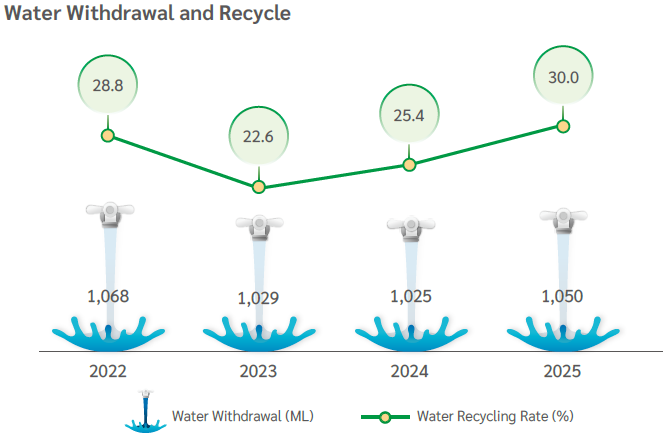
In order to make full use of water resources, USI has enhanced the reuse of water resources by improving equipment and technology. USI's total water consumption in 2025 will be 1,049.81 million liters, a decrease of 2.4% from 2024 (1,024.70 million liters), which is water intensive. The water consumption rate dropped by 15.1% compared with 2015, achieving the water saving target. In addition, the recycled water volume was 315.12 million liters, with a total recovery rate of 30%, and the process water consumption was 488.15 million liters, with a process water recovery rate of 65%.
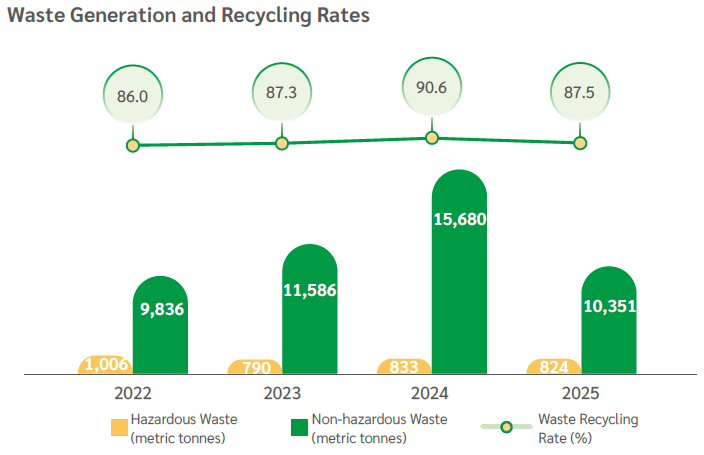
USI considers "Waste Minimization and Reuse" as corporate policy. The principles of "Impact Mitigation & Continuous Improvement" and "Effective Reduction & Circular Reuse" have been carried out thoroughly in all the facilities and treated as annual performance indicator. Therefore, through regular data record and tracking, the relevant units such as process unit, facility affairs unit, and EHS unit strictly monitor the usage and outputs, and strengthen the effective control of waste. To identify opportunities for improving waste performance, the Zhangjiang Facility, Jinqiao Facility, Huizhou Facility, Kunshan Facility, Nantou-TT, and Nantou-NK Facilities have achieved zero landfill waste through regular audits.
In 2025, USI generated 11,175 metric tonnes of waste, of which 9,783 metric tonnes were recycled, achieving an overall recycling rate of 87.5% and exceeding the annual target of 80%. Hazardous waste generation totaled 824 metric tonnes, with 241 metric tonnes recycled (29.2% recycling rate), while non-hazardous waste generation amounted to 10,351 metric tonnes, with 9,542 metric tonnes recycled (92.2% recycling rate), exceeding the annual target of 90%.
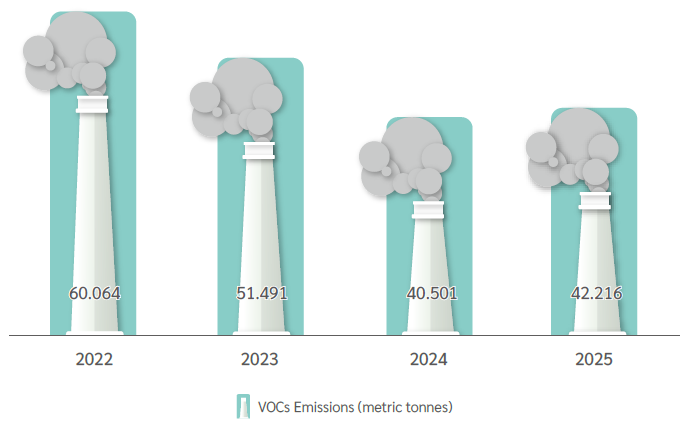
In recent years, air pollution in Mainland China and the Nantou region has become increasingly severe, with its impacts expanding and affecting the quality of life of local communities. In response, regulatory authorities have introduced more stringent air pollution control requirements. As USI’s manufacturing facilities are located within these regions, the Company places strong emphasis on the management and control of air pollutant emissions. In 2025, VOC emissions totaled 42.216 metric tons, representing a 4.2% increase compared with the previous year. The increase was primarily attributable to the use of volatile organic substances in the production processes of certain new products at specific sites, resulting in higher estimated emissions.
Regarding emissions of nitrogen oxides (NOx), sulfur oxides (SOx), and particulate matter (PM), USI has implemented a range of air pollution control measures across its manufacturing sites. Since 2019, the Jinqiao site has upgraded its boiler exhaust system and installed low-NOx burners to reduce nitrogen oxide emissions. In 2023, the Nantou Nangang Plant 1 installed a zeolite rotary concentrator and a regenerative thermal oxidizer (RTO) to reduce volatile organic compound (VOC) emissions. In addition, the Mexico site conducts particulate matter monitoring and management in accordance with local regulatory requirements to ensure effective emission control.
Moving forward, USI will continue to expand transparency by disclosing air pollutant data across more facilities and actively promoting the adoption of emission reduction measures company wide. Detailed air pollutant emissions data for 2025 is presented in the table below:
| Pollutant | Zhangjiang | Jinqiao | Huizhou | Kunshan | Nantou TT |
Nantou NK |
Mexico | Vietnam |
|---|---|---|---|---|---|---|---|---|
| Volatile Organic Compounds(VOCs) | 3.796 | 1.308 | 0.418 | 1.848 | 11.982 | 22.865 | N/A | N.D. |
| Nitrogen Oxides(NOx) | 1.022 | 0.037 | N/A | N/A | N/A | 1.820 | N/A | N/A |
| Sulfur Oxides(SOx) | N.D. | N.D. | N/A | N/A | N/A | 0.001 | N/A | N/A |
| Particulate Matter(PM) | 0.100 | 0.092 | 0.865 | N.D. | 0.001 | 0.822 | 0.961 | 14.116 |
Note: N/A: No applicable local regulation and no available self-testing data.; N.D.: Non-Detectable, the level is too low to be detected by the instrument.